
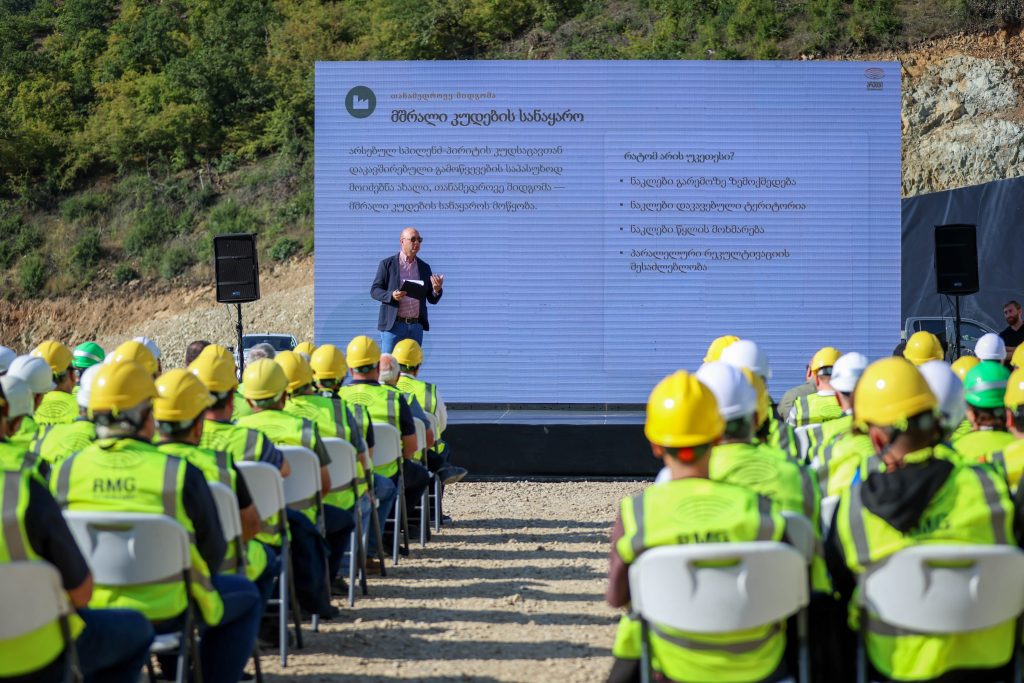
RMG has presented its new dry tailings storage facility project, along with updates on its ongoing initiatives to protect water, air, and soil. The new tailings project marks a transition to a modern method of managing and storing waste generated during ore processing.
The facility will employ dry tailings disposal technology. The slurry generated during ore processing will first be filtered at a specially designed filtration plant, followed by depositing of the resulting dry material in layers – on a specially engineered embankment.
The new technology enables more stable and controlled tailings deposition while simultaneously allowing the greening and reclamation of individual sections of the facility.
The project was preceded by several years of consultations with international specialists. Following the design phase, preparatory and construction works were carried out over a two-year period, including the construction of the embankment, a water collection reservoir, supporting infrastructure, and the filtration plant. Despite the significant investment required, the company decided to implement the project as part of its strong commitment to environmental responsibility.
“We have introduced an innovative approach to dry tailings management designed to minimize environmental impact. Another important area of development is the strengthening of our environmental monitoring unit. Effective monitoring allows us to identify the location and nature of potential environmental challenges and to plan and implement appropriate mitigation measures in a timely manner.
Another major initiative is our plan to green approximately 800,000 square meters over the next two years. This includes the reclamation and greening of waste rock dump sites, a process that is both technologically complex and time-consuming. We have already accumulated significant experience in this area” said Kote Khachapuridze, RMG’s Environmental Manager.
Today, RMG’s Environmental Protection department brings together nearly 70 specialists from a range of fields. The presentation also highlighted the strengthening of the company’s internal environmental monitoring system. The environmental monitoring unit has been upgraded to a full-fledged department staffed by 12 employees and equipped with modern measuring instruments and a mobile laboratory. Two dedicated monitoring vehicles will conduct daily inspections of designated areas, including checks to ensure compliance with water and air protection standards.
As part of its water protection measures, RMG operates four water treatment facilities across the “RMG Copper” and “RMG Gold” production sites. The most recent one has been installed this year at the copper enrichment plant. A portion of the purified water is returned to the production cycle for reuse, while the remainder is discharged into the Mashavera River at a designated discharge point.
To reduce airborne dust, the company added five new water-spraying trucks in 2026 alone. Throughout the day, the trucks spray water across operational areas as well as along roads used by ore-transporting vehicles.
RMG is also continuing its soil protection and land reclamation efforts. Work is currently underway to reclaim the slopes of the existing tailings storage facility and two waste rock dumps at the Sakdrisi deposit. The company is also implementing compensatory afforestation projects outside its operational areas. These include planting and maintenance activities on a 10-hectare site in Tetritskaro Municipality and a 3-hectare site in the village of Khatisopeli, Bolnisi Municipality. In 2024, RMG successfully completed a compensatory afforestation project in the village of Martkopi, where various perennial plant species were planted across an 11-hectare area.