
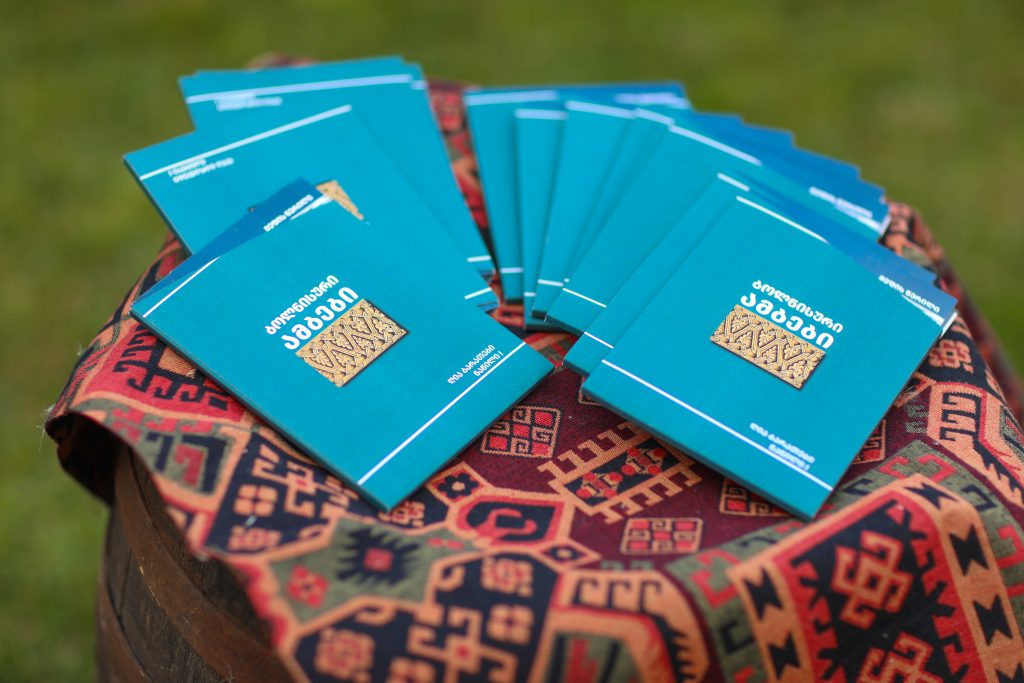
The history of Bolnisi on postcards: a project bringing local history out of the archives and into
living memory.
The first series of “Bolnisi Stories” – Postcards was presented at the Bolnisi Georgian-German
Wine House. The project brings together 20 stories exploring Bolnisi’s history, its people, cultural
heritage, and everyday life.
“Bolnisi Stories” (Bolnisuri Ambebi) is a joint initiative of the “Didgoreli” History Competition and the
National Library of Georgia, implemented with the support of RMG. The project was born from a simple
but important question: How can local history be told in a way that is engaging and accessible to
everyone—not only historians, researchers, and archivists? “Bolnisi Stories” was created as an answer to
that question.
The history of Bolnisi is rich and multi-layered. Its past is a tapestry woven from different eras and
cultures, individual lives and family histories, everyday experiences, architecture, agriculture,
winemaking, and social life. The aim of “Bolnisi Stories” is to bring this material to life—turning
historical facts into human stories and presenting them in a format that is accessible and engaging to a
broad audience.
History is not simply a chronology of major events. History is created in cities, streets, and homes, and
through the lives of families and individuals. Often, it is these small, seemingly personal stories that help
us understand the character of a city and the transformations it has experienced over time. In this sense,
“Bolnisi Stories” is more than a project dedicated to popularizing historical material; it is also an effort to
preserve and pass on local memory. The first series consists of 20 stories. Together, these diverse
narratives offer different perspectives on Bolnisi’s past—from personal accounts and important cultural
and historical milestones to the details of everyday life and the city’s winemaking traditions.
One of the project’s newness is its format. The creators of “Bolnisi Stories” chose a simple and familiar
medium for sharing historical content: the postcard. A postcard can be kept as a memento, passed on to
someone else, or carried to another city or country, allowing the story of a particular place to travel with
it. Each postcard features a relevant historical photograph accompanied by a story in both Georgian and
English. This bilingual format allows the project to reach beyond the local community, making Bolnisi’s
history accessible to foreign visitors and an international audience as well.
Particular attention was paid to the collection, processing, and verification of historical materials during
the development of the first series. With the involvement of the National Library of Georgia, historical
photographs and documents were collected and carefully processed, providing the foundation for the
selection of the first 20 stories. While each story stands on its own as an individual episode, together they
form a broader and more diverse portrait of Bolnisi and its past.
The project was implemented with the support of RMG. Promoting local history and cultural heritage is
project’s one of central objectives. Through “Bolnisi Stories,” an initiative is being advanced to uncover,
preserve, and share the history of the local community with new generations and wider audiences.
The presentation was held in a cultural and educational format. Guests had the opportunity to learn about
the origins of the project and explore a selection of the “Bolnisi Stories.” One of the highlights of the
event was a live reading of the stories, with presenters sharing narratives on a range of themes, including
Bolnisi’s history and people, urban life, and winemaking traditions. The first series of postcards was
presented as an exhibition installation, and each guest received a set as a gift. This first collection marks
the beginning of the “Bolnisi Stories” project. The authors plan to expand the series with new stories in
the future, making even more of Bolnisi’s rich historical and cultural heritage accessible to the public.